
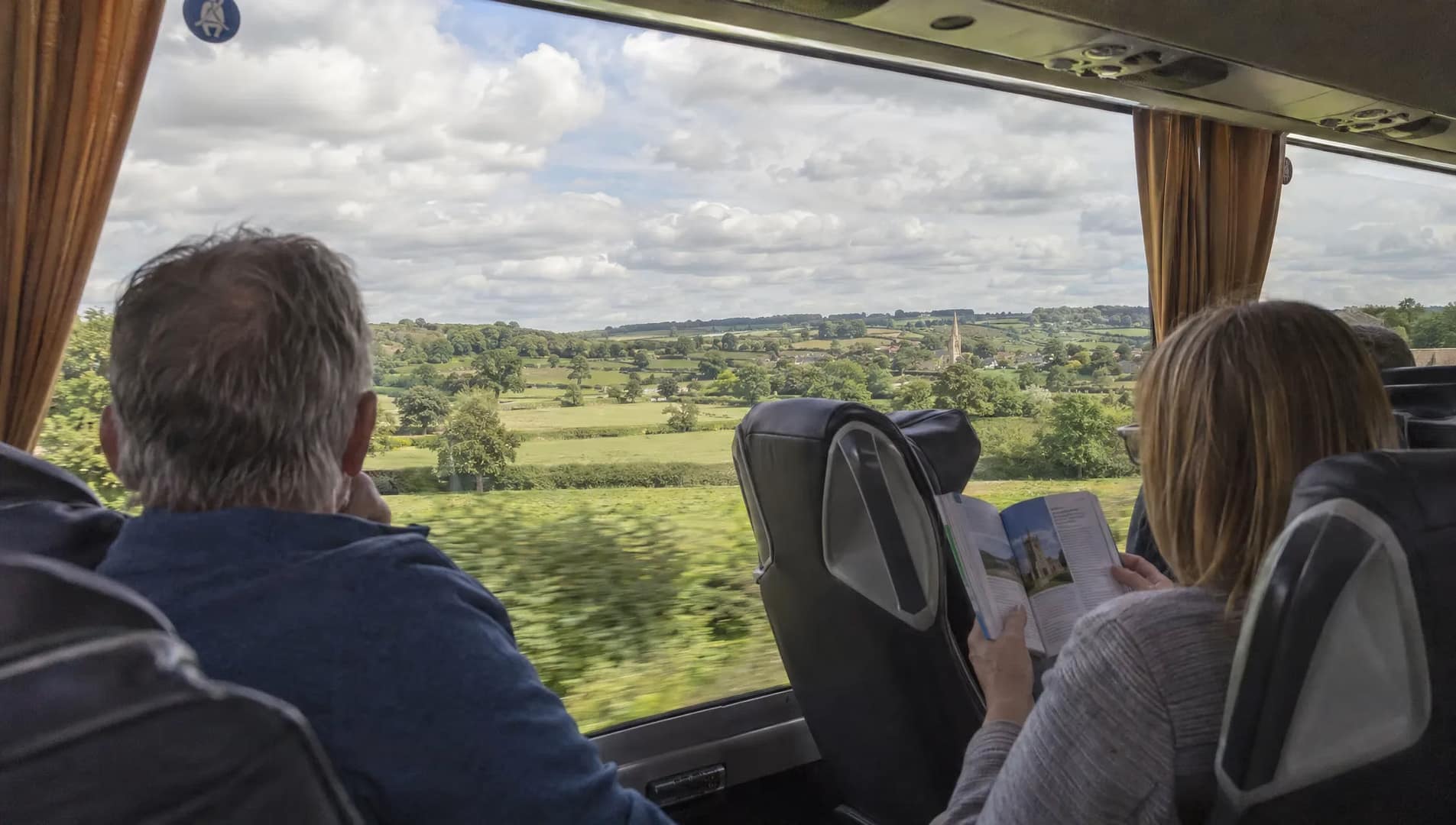
The best coach trips are not necessarily the ones with the longest list of destinations. They are the ones that let you enjoy the day at a comfortable rhythm, whether that means lingering over lunch, exploring several historic sites or watching the countryside pass between stops. Before booking, look beyond the headline attractions and check how the itinerary divides your time between travelling, walking, guided visits and independent exploring.
Consider group size and travel pace separately
Picture yourself halfway through the outing. Would you rather be following a guide into another attraction, browsing a village at your own pace or sitting down for an unhurried meal? That preference is more useful than a vague label such as “relaxed” or “leisurely”.
Travel pace has several separate parts. You might enjoy a full day of sightseeing but prefer short walks. Equally, you might be happy walking for hours yet dislike frequent departures and repeated boarding.
Write down your three most important requirements. These could be a manageable start time, enough time for a sit-down lunch and no long stretches of standing. Then identify what you can compromise on, such as seeing fewer places or arriving home later.
Choose around your least flexible requirement first. A wonderful destination will not compensate for an itinerary that consistently asks more of you than you want to give.
Compare coach trips by usable sightseeing time
A ten-hour outing does not mean ten hours of exploring. The advertised duration may include city pick-ups, motorway travel, comfort stops and the return journey.
Look for the time allocated to each destination, not just the total number of stops. A village listed on an itinerary could mean a brief photo opportunity or a substantial visit. Those are very different experiences.
The following comparison is illustrative, not a description of any operator’s schedule:
| Part of the day | More stops, shorter visits | Fewer stops, longer visits |
|---|---|---|
| Total duration | 10 hours | 10 hours |
| Travel and boarding | 6 hours | 5 hours |
| Separate meal and comfort breaks | 1 hour | 1 hour |
| Time at destinations | 3 hours | 4 hours |
| Number of destination stops | 4 | 2 |
| Average time per destination | 45 minutes | 2 hours |
Neither approach is automatically better. The first may suit someone who enjoys variety and wants an introduction to several places. The second allows more time to settle into a destination.
Ask what the published stop duration includes. If lunch, an entrance queue and the walk from the coach park all fall within a ninety-minute visit, your independent exploring time will be shorter than it first appears.
Check the physical demands separately
A comfortable seat between destinations does not tell you how demanding the sightseeing will be. When comparing coach trips, assess the walking requirements independently from the journey length.
Ask about the longest continuous walk, rather than only the total distance. Several short walks with seating between them can feel very different from one uninterrupted walk of the same overall length.
Surfaces matter too. Cobbles, slopes, gravel paths and steps can change how manageable a visit feels, especially in wet weather. Historic places may also involve standing while a guide speaks or walking some distance from the drop-off point.
If you use a mobility aid or have difficulty with steps, request specific information about boarding, storage and access at each attraction. A small vehicle is not automatically step-free, and accessibility can vary across a single itinerary.
Separate walking pace from walking ability. You do not need a mobility restriction to prefer slower sightseeing. Photography, travelling with children or simply wanting to notice the details are equally valid reasons to avoid a tightly timed route.
For general preparation, Shakespeare Coaches’ practical travel tips cover considerations such as departure points, walks and changeable weather. Use those alongside the information for your particular tour.
Decide whether you prefer variety or depth
Different destinations reward different rhythms. A countryside route can suit travellers who enjoy scenery between short visits. A city stop may be more satisfying when there is time to explore beyond a guided introduction.
For the Cotswolds, consider whether you want a series of village impressions or longer in one or two places. Neither requires you to see every notable village in a single day.
In Bath, think about what you actually want to do. Walking around the city, visiting an attraction and having lunch all draw on the same time allowance. At Stonehenge, check how the itinerary accommodates the visitor experience rather than assuming the stop is simply a roadside photograph.
The most suitable coach trips leave enough room for your main interest. If one destination is the reason you are booking, prioritise its time allocation over the number of additional places on the route.
Look for breathing space, not just a smaller group
Group size can influence the feel of a day, but it does not determine the timetable. A small group can still follow a busy itinerary, while a larger group may have generous independent time.
Shakespeare Coaches explains some of the differences in its comparison of small-group and large coach tours. For choosing your pace, the next step is to inspect the actual schedule rather than relying on group size alone.
Look for clear descriptions of guided time and free time. If a visit includes both, establish whether they are separate blocks or whether the guided walk uses most of the available stop.
Also check what happens if you skip an optional activity. There may be a suitable café or independent route nearby, but do not assume an alternative is available without asking. On a scheduled departure, the agreed meeting time still applies.

Ask questions that reveal the real pace
Broad questions such as “Is it a relaxed tour?” tend to produce broad answers. Specific questions make it easier to judge whether the day will suit you.
Before booking, ask the operator:
- How long is the longest stretch between stops? Include the journey out of the departure city, not just travel between attractions.
- How much independent time is available at the main destination? Ask whether lunch and admission queues come out of that allowance.
- What is the longest continuous walk? Check the likely terrain and whether there are opportunities to sit.
- Are toilets available during the journey and at stops? Confirm the arrangements rather than assuming there is an onboard toilet.
- Which activities are optional? Establish whether there is a practical alternative if you do not join a particular walk or visit.
- How firm is the return time? Allow for traffic when planning onward travel.
For coach trips with timed attraction entry, also ask what happens if traffic delays the arrival. The answer helps you understand how much flexibility exists within the schedule.
Read recent reviews for useful detail rather than relying only on star ratings. Comments about actual stop lengths, lunch arrangements and meeting points reveal more about pace than general praise such as “a lovely day”.
Include the journey to your departure point
Your outing begins before you board. An appealing itinerary can feel much more tiring if it requires a long transfer across London before an early departure.
Work backwards from the meeting time, allowing for the operator’s requested arrival margin. Then consider the return journey to your accommodation. Compare the whole door-to-door day, not just the hours shown on the tour page.
Season also affects how a schedule feels. Shorter winter daylight reduces the window for outdoor sightseeing, while rain or heat can make walking more tiring. Check opening arrangements for any attraction central to your plans, particularly around seasonal closures and public holidays.
If the outing falls immediately after a long flight or before an important departure, choose a less demanding schedule and leave a generous buffer. A published return time should not be treated as a guaranteed connection with a flight, cruise or last train.
Balance price against the experience you want
Value is not simply the number of destinations divided by the ticket price. A cheaper outing may still be the right choice, but check what is included and what you will need to organise during the day.
Compare admission charges, meals and optional activities on the same basis. If an attraction is not included, find out whether you need to book it independently and whether the available visit time makes that worthwhile.
For coach trips focused on a particular landmark, paying for a longer, more usable stop may offer better value than adding several places you are less interested in seeing.
If you are travelling as a group with different energy levels, discuss those differences before booking. Agree on the essential shared experiences and where independent time would help. A private tour may be worth enquiring about when a scheduled itinerary cannot meet the group’s needs, but confirm the proposed timings and access arrangements before committing.
Frequently asked questions
How can I tell whether a tour will feel rushed? Look for several substantial attractions within a short day, vague stop durations or little distinction between guided visits and free time. These are reasons to ask for clarification, not proof that the itinerary is unsuitable.
Are small-group tours always slower-paced? No. Group size and itinerary pace are separate considerations. A smaller group may make communication and boarding more straightforward, but the number of destinations and time at each stop still determine much of the day’s rhythm.
What should older travellers prioritise? Individual preferences matter more than age. Check boarding access, walking surfaces, toilet arrangements, opportunities to sit and the length of the full day. An active older traveller may want a fuller schedule than a younger traveller seeking a quiet outing.
Can I stay on the coach instead of joining a walk? Ask before booking. The vehicle may need to move or may not remain available during a stop. Confirm where you can comfortably wait and how you will rejoin the group.
Choose the itinerary you will enjoy, not just complete
Before paying, check three things: the time at your most important destination, the physical demands and the length of your door-to-door day. If those fit, the rest of the itinerary is easier to assess.
Shakespeare Coaches offers small-group day tours in 16-seat minibuses and 30-seat xl-minibuses, alongside private group tours and other travel services. Explore the available tours with Shakespeare Coaches, then ask about any timing or access detail that matters to you. The right choice should leave time to enjoy the places you came to see.