
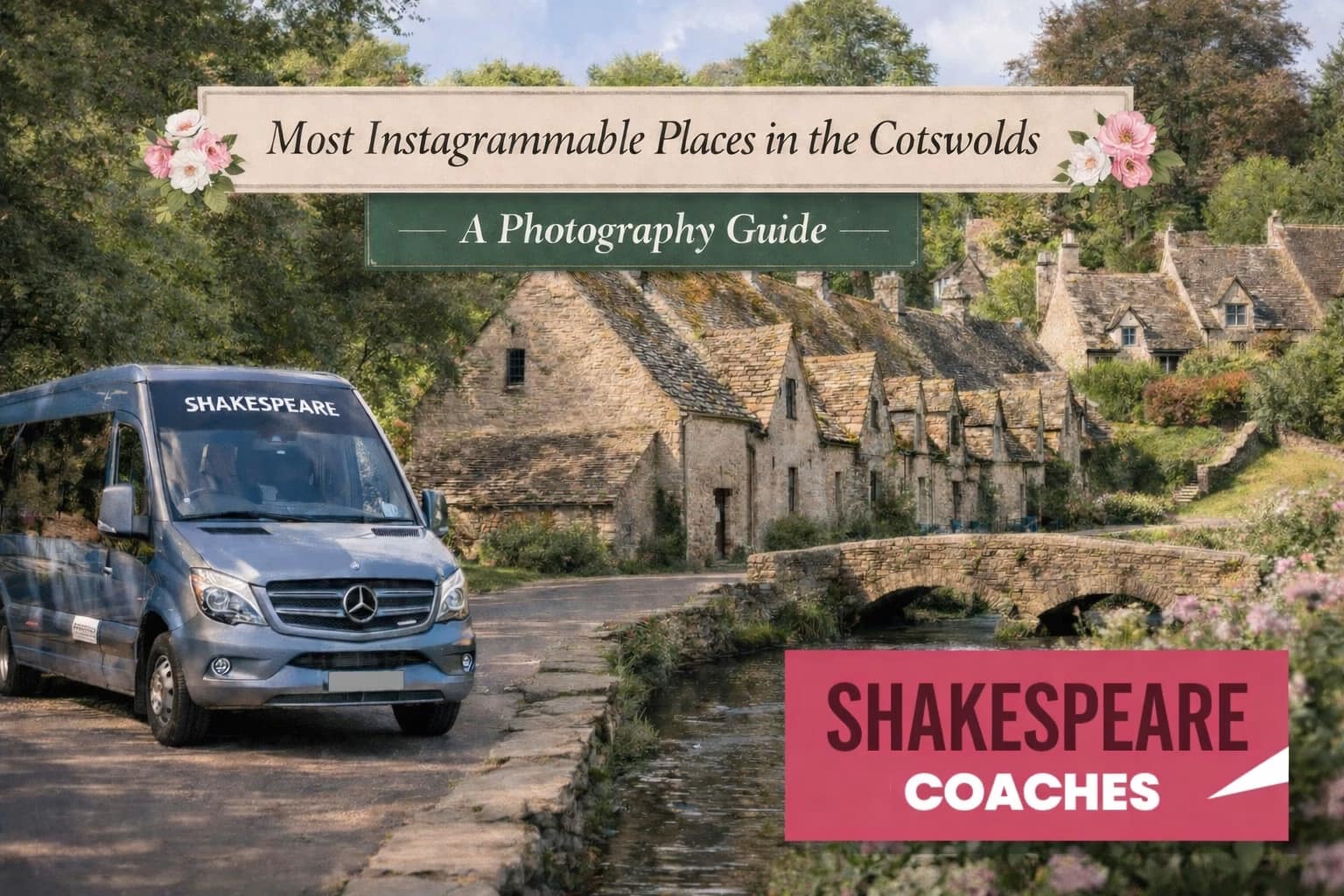
Let’s be honest: the Cotswolds was built for Instagram long before social media was even a thing. Between the honey-colored limestone, the wisteria-draped cottages, and those rolling green hills that look like they’ve been filtered by the gods, this region is basically a "cheat code" for a beautiful feed.
But here is the catch. Because it’s so stunning, everyone else has the same idea. If you’ve ever seen a photo of a deserted, misty street in Castle Combe and then turned up at 2:00 PM on a Saturday only to find three tour buses and a sea of selfie sticks, you know the "Instagram vs. Reality" struggle is real.
I’m Paul, and at Shakespeare Coaches, we spend our lives navigating these lanes. We know where the light hits the stone just right, and more importantly, we know when to get there to avoid the crowds. If you want to fill your camera roll with shots that actually look like the postcards, this guide is for you.
1. Castle Combe: The "Prettiest Village in England"
There’s a reason film crews for War Horse and Stardust flocked here. Castle Combe is consistently voted the prettiest village in the country, and for good reason. It has no new houses built since the 1600s, meaning your photos won’t have a single modern eyesore in sight.
The Money Shot: Head down to the bridge over the River Bybrook. Looking back toward the village, you get the perfect framing: the water in the foreground, the winding road, and the ancient weaver’s cottages leading your eye up toward the church.
Pro Tip: This spot gets packed. To get it empty, you either need to be there at 7:00 AM or stay late after the day-trippers have left. If you’re joining us on a Cotswolds day tour from London, we try to use our "backdoor" timing to miss the worst of the rush.

2. Bibury: The Iconic Arlington Row
You’ve probably seen Arlington Row on the inside cover of British passports. These 14th-century monastic wool stores are arguably the most photographed group of buildings in the Cotswolds. The way the roofline wonkily undulates against the backdrop of the Rack Isle marshland is pure magic.
The Money Shot: Don’t just stand directly in front of the houses. Walk a little way down the path toward the Swan Hotel and look back. The perspective of the row curving away from you creates a much more dynamic image.
The Reality Check: Bibury is tiny. Because it’s so famous, the "main" road can get congested. If you want a shot without a rogue tourist in a neon jacket, patience is your best friend. Or, better yet, visit on a weekday in the shoulder season.
3. Snowshill: Lavender Fields and Hidden Valleys
Snowshill is a bit of a hidden gem compared to the "big hitters," which is exactly why it’s so photogenic. It sits on top of the escarpment, looking down into a secluded valley. It feels like a place time forgot: mostly because there’s no through traffic to ruin the vibe.
The Money Shot: If you’re here in July or August, the Cotswold Lavender fields just outside the village are a must. Rows of deep purple stretching toward the horizon with a classic English barn in the distance? That’s peak Instagram content right there. Inside the village, the view from the churchyard looking toward the village green is quintessentially English.
Pro Tip: Snowshill is hilly. Wear comfortable shoes! If you’re planning a visit, check out our Travel Tips for advice on what to pack for a day of walking and shooting.

4. Stow-on-the-Wold: The "Narnia" Door
Stow is the highest of the Cotswold towns, and while the Market Square is great for street photography, there is one specific spot that everyone hunts for: the north door of St Edward’s Church.
The Money Shot: This door is flanked by two massive, ancient yew trees that have grown into the stonework over centuries. It looks exactly like a portal to another world: specifically, it’s rumored to have inspired J.R.R. Tolkien’s "Doors of Durin" in The Lord of the Rings.
Pro Tip: The lighting here can be tricky because of the heavy tree cover. A slightly overcast day actually works better than bright sunlight, as it prevents harsh shadows from obscuring the detail in the wood and stone.
5. Bourton-on-the-Water: The Venice of the Cotswolds
Bourton is famous for the River Windrush which runs right through the center of town, crossed by several low, elegant stone bridges. It’s undeniably beautiful, but it’s also the most popular village in the region.
The Money Shot: Find a spot by one of the bridges where you can capture the reflection of the golden-stone shops in the clear, shallow water. If you can catch a local walking a dog across the bridge, even better.
The Strategy: Because parking here is a nightmare (seriously, check our guide on Cotswolds car parks when we post it!), many people find it stressful. When you’re on a Shakespeare’s Stratford-upon-Avon & Cotswolds Day Tour from London, we drop you right in the heart of it, so you can spend your time composing shots instead of circling for a parking space.

6. The Slaughters: Lower and Upper
Don’t let the name scare you off; it comes from the Old English word "Slohtre," meaning "muddy place." Thankfully, they are far from muddy today. Lower Slaughter is home to a stunning old mill (now a museum and shop) with a giant waterwheel that makes for an incredible focal point.
The Money Shot: Stand on the small footbridge near the Old Mill and shoot back toward the cottages. The river is very shallow here, often reflecting the cottages and the weeping willows perfectly.
The "Insider" Move: Walk the mile-long path between Lower and Upper Slaughter. It’s an easy, flat walk that offers sweeping views of the countryside and sheep-filled pastures that are perfect for those "slow living" aesthetic shots.

7. Broadway Tower: The Highest Viewpoint
If you want a panoramic view that captures the "rolling" part of the rolling hills, you have to go to Broadway Tower. It’s an 18th-century "folly" perched on the second-highest point in the Cotswolds. On a clear day, you can see across 16 different counties.
The Money Shot: Capture the tower itself from a distance to show its dramatic isolation against the sky. Or, if you have a drone (check local regulations first!), the aerial views of the escarpment are breathtaking.
Photography Tips for the Cotswolds
To make sure your photos actually stand out, keep these tips in mind:
- The "Golden Hour" is King: The honey-colored Cotswold stone reacts beautifully to the low, warm light of sunrise and sunset. In the middle of the day, the stone can look a bit "flat" or overly yellow.
- Look for the Details: Don’t just take wide shots. Zoom in on the iron door knockers, the overflowing flower boxes, the thatched roofs, and the ancient stone carvings on the churches.
- The "Human Element": A photo of a street is nice; a photo of a person walking a dog or a vintage car driving through that street tells a story.
- Avoid the Crowds: We can’t stress this enough. If you want the best photos, you have to beat the crowds. This is why we advocate for our Small Group Backdoor Strategy. We take the smaller roads and time our stops to give you the best chance of a clear shot.

Capturing the "Raw" Cotswolds
While everyone is busy chasing the same five shots in Bibury, there is a whole world of raw, golden soul in the lesser-known villages. Places like Stanton, Stanway, or Great Tew offer incredible photography opportunities without a single other tripod in sight.
At the end of the day, the best photo is the one that reminds you of how you felt being there. The Cotswolds isn't just a backdrop; it’s an atmosphere. It’s the smell of woodsmoke in the air, the sound of the river, and the feeling of walking on stones that have been there for five hundred years.
If you’re ready to see these spots without the stress of navigating narrow lanes and fighting for parking, come join us. Whether it’s a transfer from Stratford to London with some scenic stops or a full Shakespeare’s Stratford-upon-Avon & Cotswolds Day Tour from London, we’ll make sure you get the shots (and the memories) you’re looking for.
Happy shooting!