

Stonehenge tours from London tend to sell you a postcard. This is the real thing: wind on Salisbury Plain, 25-ton stones that don’t care about your camera, and a silence that refuses to explain itself. Come in small-group, take the long walk in, and let the mystery stay sharp.
Stonehenge isn’t a postcard. It’s not a neat little “must-see” on a laminated itinerary. It’s a prehistoric heavy-metal monument to time and ego—an obscene amount of effort, violence (of the body, at least), and stubborn belief made physical. It sits out on Salisbury Plain like a knuckle left behind after a fight you don’t remember.
You hear it before you feel it. The wind. The long, unromantic hiss of it crossing open ground. The sound of your own boots on the path. The small talk dying off as people realise the place doesn’t care about them.
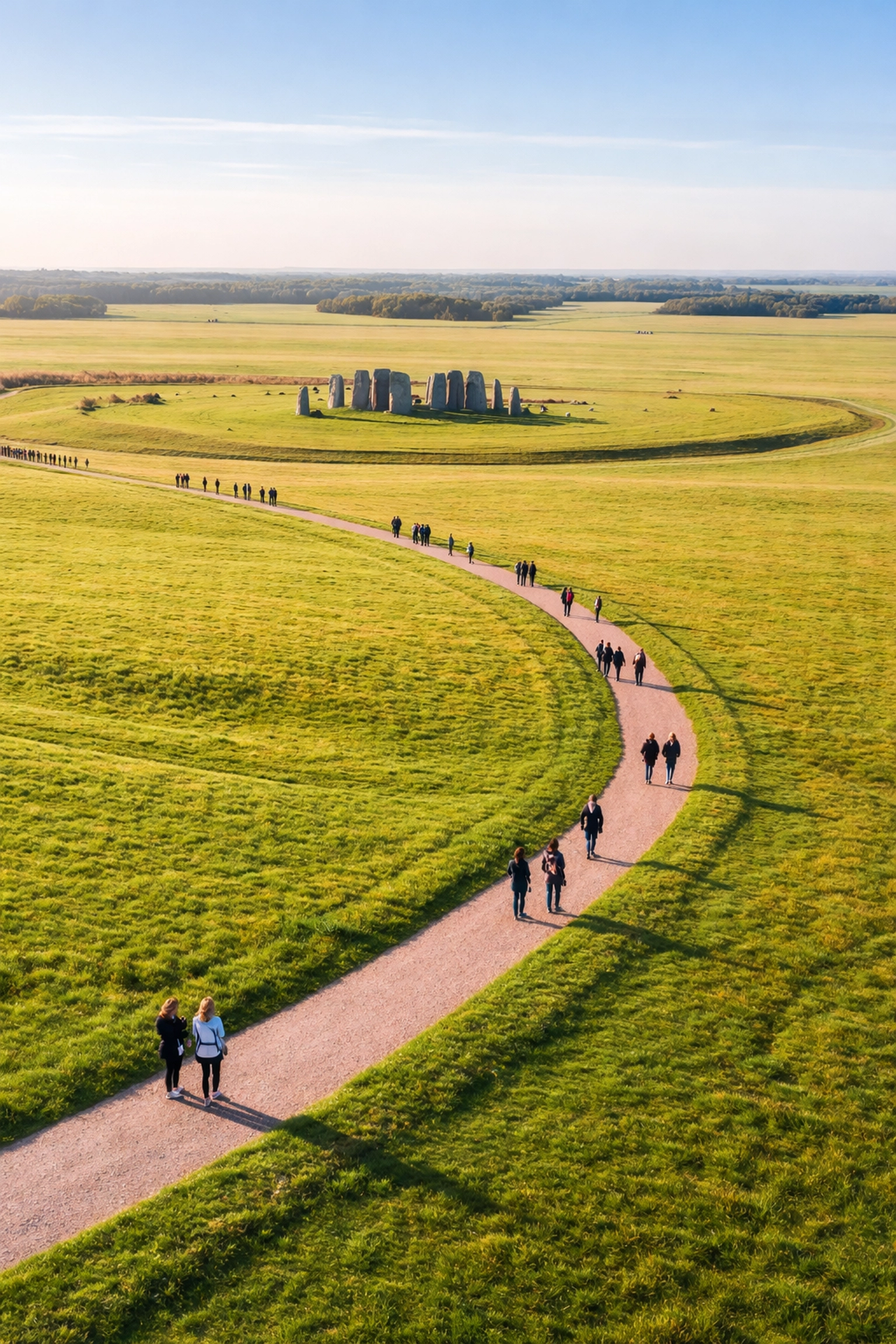
And then you see the stones. From a distance, they can look weirdly manageable—like something you’ve already “done” in your head because you’ve seen them a thousand times on screens. But you keep walking. The circle swells. The uprights turn into walls. The lintels stop being “stones” and start being weight. Not metaphorical weight—actual tonnage, pressing down on the landscape like a hand.
This is the bones-of-Britain stuff. Not kings and castles. Not the souvenir-shop version of history with a tasteful font and a Union Jack fridge magnet. This is older than England. Older than the idea that anything here belonged to anyone.
“Travel isn’t always pretty. It isn’t always comfortable. Sometimes it hurts, it even breaks your heart. But that’s okay. The journey changes you; it should change you.” — Anthony Bourdain (via azquotes: https://www.azquotes.com/quote/392871)
Stonehenge, Up Close: Wind, Silence, and Sheer Mass
Let’s get the nerdy numbers out of the way, because they don’t kill the romance here—they sharpen it.
The biggest sarsens come in around 25 tonnes, sometimes more depending on who you ask. These things were hauled from the Marlborough Downs, about 25 miles away, by people with no wheels, no engines, no forklifts, no “health and safety.” Just rope, timber, bruises, and a kind of communal obsession.
And then there are the bluestones—up to four tonnes each—dragged from the Preseli Hills in Wales. Roughly 150 miles, which is absurd even with modern roads. You don’t move stones like that unless you’re trying to say something to the future. Unless you’re marking death, or god, or the sun, or the power of the group over the individual. Maybe all of it.
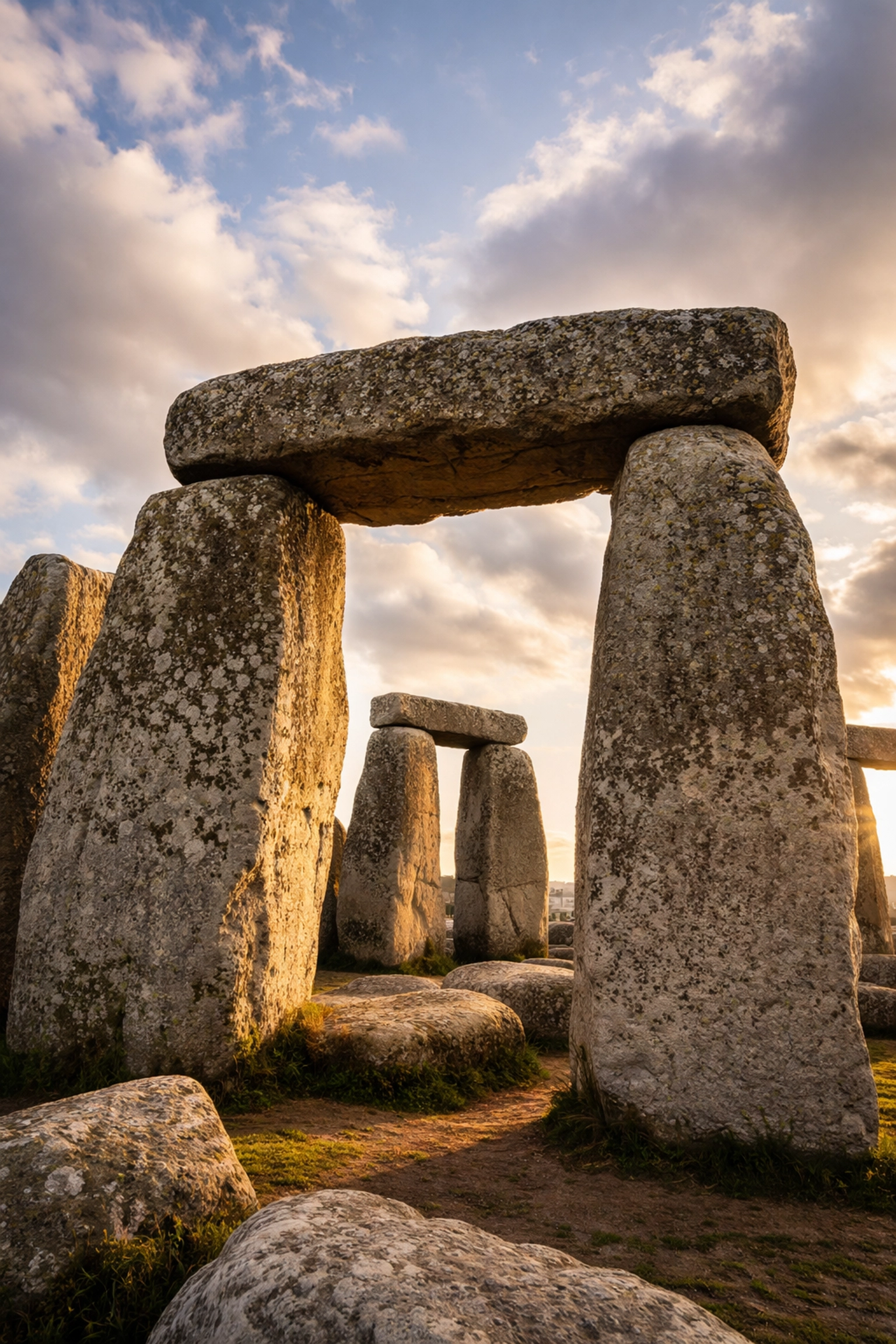
Standing there, you feel the raw mechanics of it. The stones aren’t delicate. They’re not “ancient” in the museum sense. They’re scarred. Weathered. Pitted. They look like they’ve been taking punches from the sky for five thousand years—and they’re still standing.
The silence isn’t total, because this is modern Britain and there’s always a road somewhere doing what roads do. But there’s a different silence: the kind you get when something is too old to explain itself to you. The kind that makes you lower your voice without being told.
Mystery vs. the Modern Addiction to Answers
Everyone wants Stonehenge to be one thing. A calendar. A temple. A healing centre. A burial ground. A cosmic machine built by geniuses, or aliens, or Druids (who showed up thousands of years later, but sure).
It’s comforting to have a label. Humans love labels. They make the world feel less big and less indifferent.
The problem is: Stonehenge resists that. Archaeology tells us it changed over time—built, altered, re-altered—over roughly 1,500 years. It wasn’t one clean project with a single purpose. It was a long argument with the universe, fought in stone and sweat, passed down to people not yet born.
We know there were cremated remains here. We know there were gatherings and feasts. We know the alignment with the midsummer sunrise and midwinter sunset is real, and deliberate. We also know—if we’re being honest—that most of the tidy explanations are us trying to scratch an itch.
Stonehenge offers you a gap in knowledge that won’t close just because you bought a ticket.
London to Stonehenge: The Ritual of Approach (And Why Small Groups Matter)
A lot of “Stonehenge tours from London” feel like a cargo run. Load. Unload. Photograph. Reload. Like you’re being processed.
But the journey out matters. Leaving London is like shedding a skin: the city noise, the sharp edges, the constant need to do something. You push west and the land opens up. Fields. Hedgerows. Big skies. The sort of countryside that looks calm until you remember how many people have bled on it, farmed it, been buried under it.
In a small group—16 seats, not a 50-person coach—you can actually feel the approach. There’s room for quiet. Room for a guide to tell you what’s worth knowing without turning it into a TED Talk. Room for you to stare out the window and let your mind catch up.
That’s the ritual: not just arriving, but earning the moment with a bit of road and a bit of silence.
And when you get there, skip the shuttle if you can. Walk from the visitor centre. The path is a slow reveal—grass underfoot, wind in your face, the stones growing larger and less theoretical with each step. The shuttle drops you like a delivery. The walk makes it a pilgrimage.
Visiting Stonehenge Without Losing Your Mind (Or Your Soul)
Stonehenge can be disappointing if you show up looking for a cinematic “moment.” The roped path can feel like an apology. The crowds can turn the air into a low-grade hum of phones, audio guides, and performance.
So here’s the honest play:
Go early if you can. Morning light has a way of making the place look less like an attraction and more like a fact. Before the day-trippers stack up, you can stand there and hear the wind do its work.
If you can book inner circle access, do it—walking among the stones changes your sense of scale in a way photos never will. If you can’t, don’t let it ruin the visit. You don’t need to touch them to feel what they are.
And try—really try—to ignore the gift shop gravity. That soft pull toward easy meaning you can carry home in a bag. Stonehenge isn’t merchandise. It’s a question left on the table.
Stonehenge and Bath: Two Different Kinds of Human Ambition
Pairing Stonehenge with Bath makes sense because they’re a conversation—just not a polite one.
Stonehenge is raw prehistory. Belief without a written manual. Labour without a brand name attached. A monument that refuses to explain itself.
Bath is civilisation showing up with money and engineering and hot water, building beauty on purpose. Roman stone. Georgian symmetry. Human beings trying to make life comfortable, organised, and legible.
Do both, and you feel the timeline in your bones: from the mute weight of the stones to the curated elegance of a city that knows exactly what it is.
What the Stones Ask of You
Stonehenge doesn’t give you answers. It gives you time. It gives you scale. It gives you that slightly uncomfortable feeling that the world was here long before you—and doesn’t particularly need you now.
Stand there for a few minutes without rushing to interpret it. Let the wind hit your face. Let the silence work on you. Let the thing be what it is: not a postcard, not a product, not a tidy story—just a heavy, stubborn fact in the landscape.
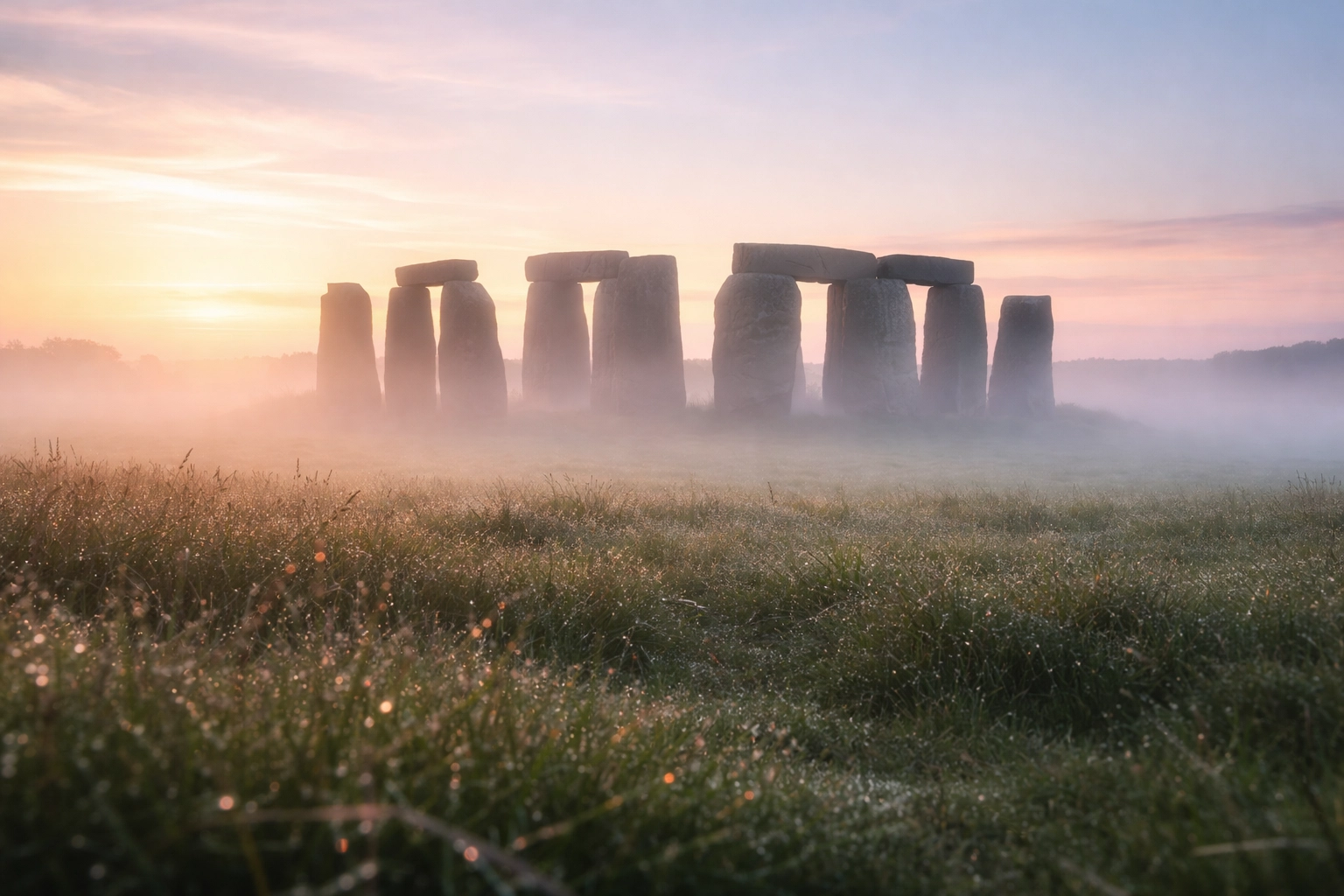
And when you walk away, you’ll understand the strangest part: you didn’t come for certainty. You came for the permission to not have it.
Ready to do Stonehenge properly—without the big-coach churn? Explore our small group tours from London and take the long way in.
Ready to experience Stonehenge without the crowds? Explore our small group tours from London and discover why the journey matters as much as the destination.