

![[LOGO] Shakespeare Coaches](https://cdn.marblism.com/5SxIhtM0vwb.jpg)
If you’ve ever looked at a postcard of the English countryside and thought, "There’s no way a place actually looks like that," you probably haven't been to Painswick. Known affectionately as the “Queen of the Cotswolds,” this town isn't just a pretty face. It is a historic powerhouse built on the back of the medieval wool trade, perched on a hill with views that would make a landscape painter weep.
At Shakespeare Coaches, we’ve spent years navigating the winding lanes of Gloucestershire, and Painswick remains one of our absolute favorite stops. It’s quieter than the tourist magnets like Bourton-on-the-Water, but it packs a massive punch in terms of history and atmosphere.
Whether you're planning a Cotswolds tour in a day or a private escape, here is your no-nonsense guide to making the most of Painswick.
The TL;DR: Painswick at a Glance
Don’t have time for the deep dive? Here’s the "cheat sheet" for your visit:
- The Vibe: Elegance, honey-colored stone, and quiet sophistication.
- Don't Miss: The 99 Yew Trees at St Mary’s Church and the Rococo Garden.
- Best Photo Spot: Standing in the center of the churchyard or looking out from Painswick Beacon.
- Fun Fact: It’s the midpoint of the 102-mile Cotswold Way walking trail.
- Pro Tip: Wear comfortable shoes. The "hill" part of "hill town" is no joke.

Why is it the "Queen" of the Cotswolds?
Painswick earned its royal nickname because it is one of the best-preserved settlements in the region. While other villages have modern developments creeping in at the edges, Painswick feels frozen in a very specific, very wealthy era of British history.
The town grew rich during the peak of the wool industry. Unlike the smaller agricultural hamlets nearby, Painswick was a town of merchants. You can see this in the architecture: grand houses with south-facing attic windows. Why south-facing? Because that’s where the weavers needed the best light to work their looms.
The name itself comes from Pain FitzJohn, a Norman lord who held the manor in the 12th century. Over time, "Pain’s Wyke" (Pain’s settlement) became Painswick. Today, it stands as a testament to the "Golden Age" of the Cotswolds, where every stone seems to have a story to tell.
St Mary’s Church and the Legend of the 99 Yews
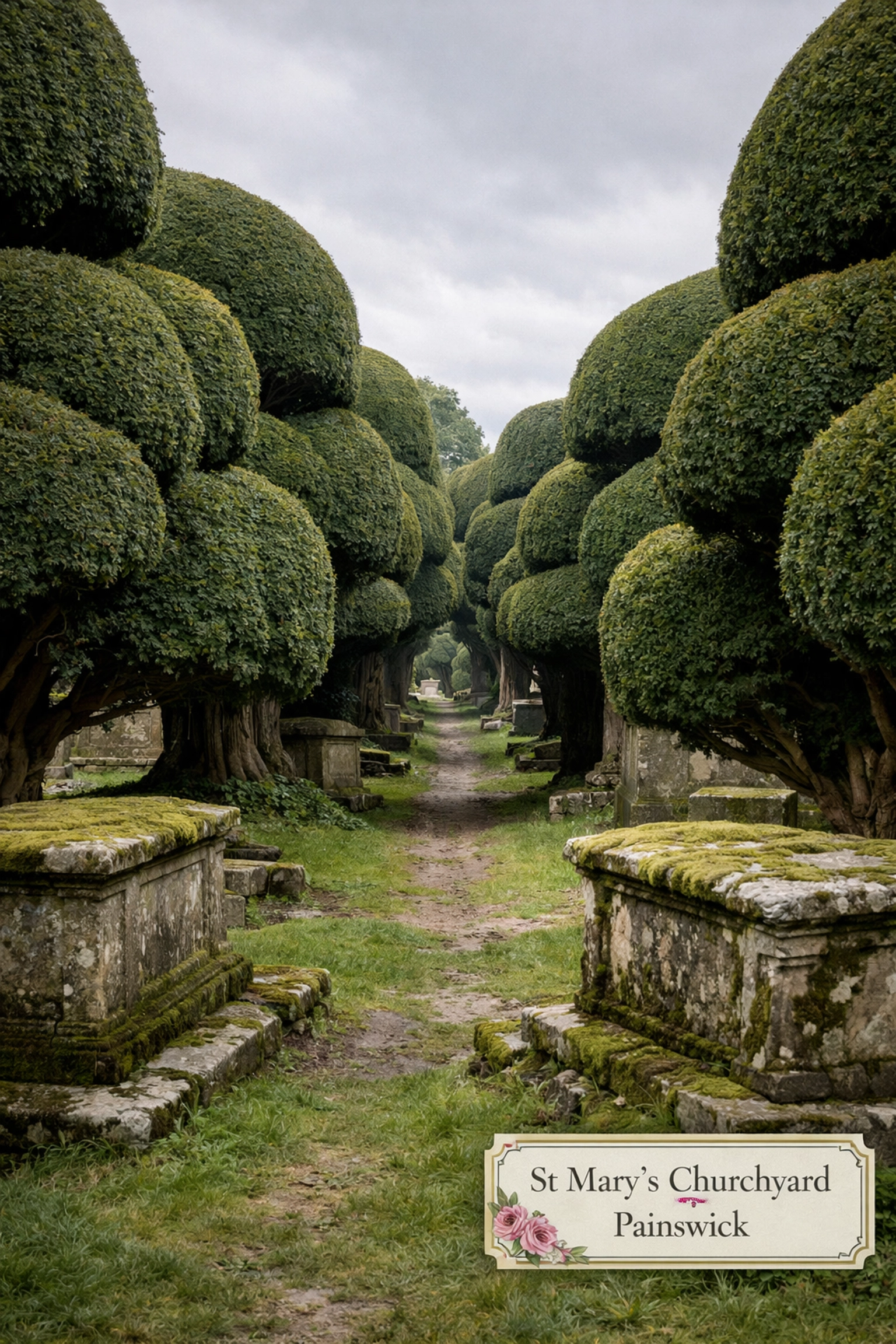
You cannot visit Painswick without stepping into the churchyard of St Mary’s. It is, quite simply, one of the most surreal sights in England. The yard is filled with massive, perfectly manicured yew trees: 99 of them, to be exact.
The Legend: Local folklore says that the 100th tree will never grow. According to the tale, the devil himself pulls out the 100th sapling every time it’s planted. Whether you believe in the devil’s gardening habits or not, the 99 trees create a hauntingly beautiful canopy that is perfect for photography.
The Architecture: The church itself dates back to the 14th century, though much of what you see today is from the 15th-century wool wealth. Look closely at the spire; it was added in 1632 and has survived lightning strikes and the English Civil War.
"Clipping the Church": If you happen to visit on the Sunday after September 19th, you’ll witness a tradition dating back hundreds of years. Local children join hands to form a circle around the church, "clipping" (an old word for embracing) the building to show their love and protection for it.
The Painswick Rococo Garden: A Hidden 18th-Century Playground
A short walk from the town center lies the Painswick Rococo Garden. This isn't your typical formal English garden with straight lines and stiff hedges.
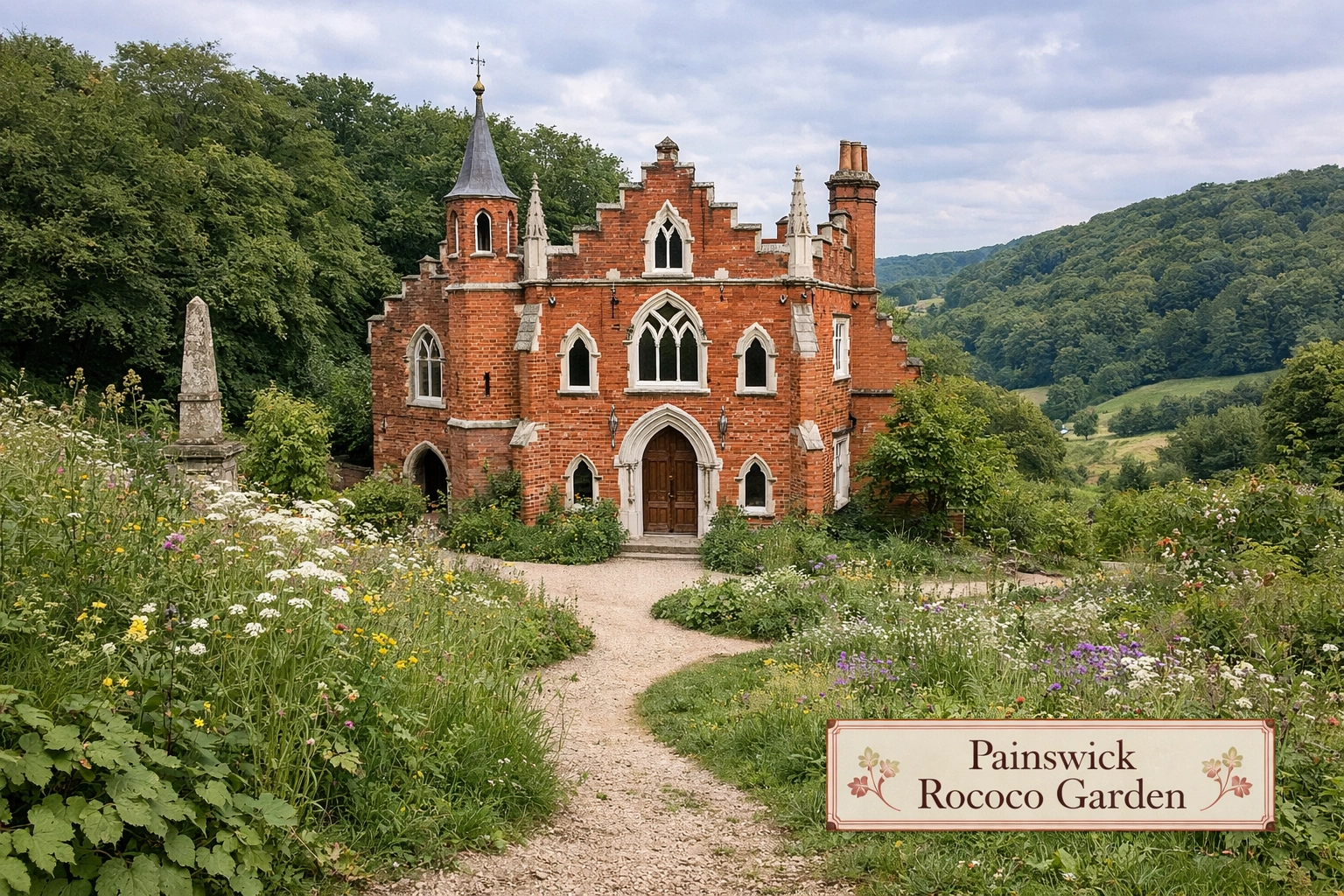
Rococo was a brief, flamboyant fashion in the mid-1700s. It was all about curves, whimsy, and showing off. Designed in the 1740s for Benjamin Hyett as a place to entertain his wealthy friends, the garden is tucked away in a hidden valley. It features:
- Fanciful Pavilions: Little "follies" designed just for the sake of looking pretty.
- The Red House: A striking Gothic building that looks like something out of a fairytale.
- Seasonal Displays: It is world-famous for its carpet of snowdrops in late winter and its stunning wildflower meadows in the summer.
For those on a Shakespeare’s Stratford and Cotswolds tour, the Rococo Garden offers a peaceful contrast to the busier market towns.
Walking the Narrow Streets: Architecture and Hidden Gems
Painswick is a town made for wandering. Because the streets were designed for packhorses and foot traffic rather than 50-seater tourist buses, the layout is wonderfully intimate.
- The Oldest Post Office: Painswick claims to have the oldest building in England that has been a post office. It’s a classic Cotswold stone structure that still serves the local community today.
- Iron Age Roots: If you have an extra hour, hike up to Painswick Beacon. You’ll find the remains of an Iron Age hillfort and, on a clear day, views that stretch across the Severn Vale all the way to the Welsh mountains.
- Local Stones: Notice the color of the buildings. Painswick stone is a particularly pale, creamy variety of limestone quarried right on the hill. It gives the town a "shining" quality, especially just after a rain shower when the sun breaks through.
Visiting Painswick from London: Why Small Groups Matter
Many people try to see the Cotswolds via large coach tours departing from London. Here’s the problem: Painswick doesn't like big buses. The narrow lanes and sharp corners make it nearly impossible for large coaches to navigate the heart of the town.
At Shakespeare Coaches, we specialize in small group tours (maximum 16 people). This allows us to:
- Get Into the Heart of the Village: We park where the big buses can't, meaning less walking for you and more time spent seeing the sights.
- Personalized Pacing: We don't rush you through the 99 yew trees. You have time to sit, have a coffee at a local cafe, and actually soak in the atmosphere.
- Expert Insight: Our drivers know the history of Lord Pain FitzJohn and the wool merchants like the back of their hand.
If you’re looking for a London to Stratford-upon-Avon and Cotswolds experience that includes the "Queen of the Cotswolds," a small group tour is the only way to go.
Final Thoughts for Your Painswick Guide
Painswick isn't a museum; it’s a living town. When you visit, take a moment to step away from the main churchyard. Walk down the side alleys, look at the intricate stone carvings on the doorways, and perhaps stop for a pint at The Falcon, which has been serving locals since the mid-1500s.
It is a place of quiet beauty and immense history: a true highlight of any trip to the English countryside.
The Cotswolds Mega-Guide Series: Top 25 Villages
Painswick is just one jewel in the crown. We are documenting the top 25 destinations in the Cotswolds to help you plan your perfect trip. Follow the links below to explore each village in our "No-Nonsense Guide" series:
- Bourton-on-the-Water – The Venice of the Cotswolds.
- Bibury – Home to the iconic Arlington Row.
- Castle Combe – Frequently voted the prettiest village in England.
- Stow-on-the-Wold – The historic market town with the "Tolkien Door."
- Chipping Campden – The heart of the Arts and Crafts movement.
- Burford – The gateway to the Cotswolds with a famous sloping high street.
- Broadway – Known for its wide street and the iconic Broadway Tower.
- Painswick – The "Queen of the Cotswolds" (You are here!).
- Snowshill – A tiny, quirky village famous for its manor and lavender fields.
- Upper Slaughter – A peaceful riverside hamlet frozen in time.
- Lower Slaughter – Home to one of the most romantic streets in Britain.
- Lacock – A film-maker's dream (Harry Potter and Downton Abbey).
- Malmesbury – Famous for its stunning hilltop Abbey.
- Winchcombe – The walking capital of the Cotswolds.
- Tetbury – Famed for antiques and its royal connection to Highgrove.
- Cirencester – The "Capital of the Cotswolds" with Roman roots.
- Moreton-in-Marsh – A vibrant market town with great rail links.
- Woodstock – The gateway to Blenheim Palace.
- Blockley – A former silk-mill village with unique charm.
- Stanway – Home to a magnificent manor and the tallest gravity fountain.
- Minster Lovell – Atmospheric ruins and thatched cottages.
- Great Tew – A picture-perfect estate village.
- Stanton – Widely considered one of the most unspoiled villages.
- Corsham – A hidden gem with roaming peacocks.
- Bampton – Famous as the filming location for "Downton Village."
Ready to see the Queen of the Cotswolds for yourself? Book your small group tour here and let Shakespeare Coaches show you the best of England.